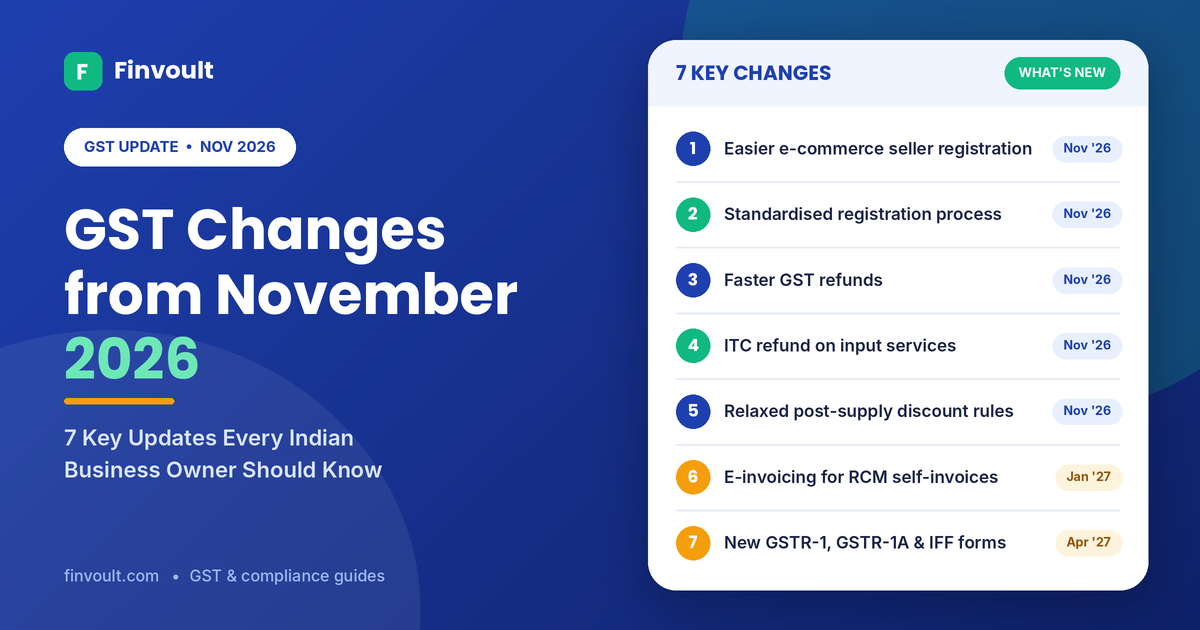
GST compliance in India is changing again. Following the 57th GST Council meeting held on 8 October 2026, the government has begun rolling out a series of reforms that affect registration, refunds, discounts, invoicing, and return filing.
The changes are being introduced in phases. Some took effect on 1 November 2026, some begin in December 2026 or January 2027, and others are targeted for April 2027. That makes it important to know which changes apply today and which are still ahead.
In this article, we explain the 7 key GST updates, what they mean for your business, and how to prepare.
1. Easier Multi-State Registration for Small E-Commerce Sellers
Until now, a seller who wanted to sell across several states through an online platform often needed separate registrations and a physical place of business in each state.
From 1 November 2026, eligible small online sellers can declare an e-commerce operator’s warehouse as their principal place of business in another state or Union Territory, subject to prescribed conditions. This is introduced through Rule 14B.
Key points
It is meant for small sellers whose input tax credit passed on is up to ₹2.5 lakh per month.
The seller must have a genuine presence in at least one state, where Aadhaar authentication and physical verification are completed.
Registrations in other states require the e-commerce operator’s consent.
Government estimates suggest nearly 9.5 lakh small sellers could benefit.
Why it matters: Expanding to new states becomes easier, and fewer physical offices and verifications are needed.
2. A More Standardised GST Registration Process
From 1 November 2026, GST registration applications follow standardised documentation requirements. The portal is also expected to offer clearer navigation, drop-down menus, and guidance tools.
The aim is to reduce application rejections, cut down on queries from tax officers, and speed up approvals.
What you should do: Keep your documents ready and consistent before applying: PAN, address proof, bank details, and proof of the business premises.
3. Faster GST Refunds
Refunds are one of the biggest working-capital pain points for exporters and manufacturers. The reforms aim to speed them up in two ways:
Refund claims for excess balance in the electronic cash ledger are to be processed automatically, without a tax officer’s intervention.
For zero-rated supplies and inverted duty structure cases, 90% of eligible claimed refunds can receive provisional approval through an automated, risk-based system.
Why it matters: Cash stuck in refunds can now be released faster, which helps exporters and manufacturers most.
4. Refund of Accumulated ITC on Input Services (Inverted Duty)
Under an inverted duty structure, the tax on inputs is higher than the tax on the final product, so credit piles up.
Earlier, refund of this accumulated credit was largely limited to inputs (goods). Under the reforms, input tax credit on input services availed on or after 1 November 2026 becomes eligible for refund under the inverted duty structure, subject to the applicable legal changes.
What you should do: If you operate in an inverted duty sector, track input-service credits separately by date of availment. Only credit availed on or after 1 November 2026 qualifies.
5. Relaxed Rules for Post-Supply Discounts
Businesses often give discounts after the sale, such as volume rebates, year-end incentives, or festive schemes. Earlier, claiming the tax benefit of such discounts needed a pre-existing agreement and a link to specific invoices.
From 1 November 2026, businesses no longer need pre-existing agreements or invoice-specific linkages for such discounts, subject to safeguards involving credit notes and ITC reversals.
Tax professionals note this could particularly help FMCG, manufacturing, and MSME businesses with working-capital management.
What you should do: Issue proper credit notes for post-supply discounts and ensure the recipient reverses ITC accordingly.
6. E-Invoicing Extended to Reverse-Charge Self-Invoices
This is the change that matters most for anyone who issues invoices. Under notifications issued on 26 October 2026, e-invoicing is being extended to self-invoices raised under reverse charge in two cases:
RCMDOM: supplies received from unregistered persons
RCMIMP: import of services
According to a GSTN advisory dated 17 November 2026:
From 15 December 2026, businesses can voluntarily generate IRNs for these self-invoices on the production Invoice Registration Portals.
From 1 January 2027, e-invoicing for these transactions becomes mandatory.
Use the sandbox, not the production portal, for test data.
Who is affected? Businesses already covered by e-invoicing that pay GST under reverse charge on purchases from unregistered suppliers or on imported services.
What you should do: Check that your billing or accounting software can generate e-invoices for RCM self-invoices. Test in the sandbox in December so the January switch is smooth.
7. Draft GSTR-1, GSTR-1A and IFF Forms Open for Consultation
The Finance Ministry has placed draft revised forms for GSTR-1, GSTR-1A, and the Invoice Furnishing Facility (IFF) on the myGov portal for public consultation until 30 November 2026. The revised forms are scheduled to take effect from 1 April 2027.
Some other reforms, such as changes to arrest provisions, prosecution thresholds, and e-way bill rules, are also targeted for April 2027 because they need amendments to GST law.
What you should do: Review the draft forms and share feedback before the consultation closes, or at least start planning how your invoicing data will map to the new formats.
GST Changes: Important Dates at a Glance
Change Effective date
E-commerce seller registration facility (Rule 14B) 1 November 2026
Standardised registration documentation 1 November 2026
Faster refund processing Phased from 1 November 2026
Refund of ITC on input services (inverted duty) Credit availed on or after 1 November 2026
Relaxed post-supply discount rules 1 November 2026
Voluntary e-invoicing for RCM self-invoices 15 December 2026
Mandatory e-invoicing for RCM self-invoices 1 January 2027
Revised GSTR-1, GSTR-1A and IFF 1 April 2027 (targeted)
Draft form consultation closes 30 November 2026
Dates and conditions can change through later notifications, so always verify on the official GST portal.
Does the ₹5 Crore E-Invoicing Limit Still Apply?
E-invoicing applies to businesses whose aggregate turnover crossed the notified threshold in any financial year from 2017-18 onwards, currently ₹5 crore. The November 2026 updates do not change this threshold; they extend e-invoicing to additional types of transactions (RCM self-invoices) for businesses already covered. E-invoicing is for taxable B2B supplies and exports, not for B2C bills or exempt supplies, which use a Bill of Supply.
GST Compliance Checklist for Late 2026
Check whether your business falls under the e-invoicing threshold.
Identify purchases on which you pay GST under reverse charge.
Test RCM e-invoice generation in the sandbox before 1 January 2027.
Record post-supply discounts with correct credit notes.
Separate input-service ITC by date of availment if you are in an inverted duty sector.
Review refund claims pending on your GST portal.
Share feedback on draft GSTR-1 and IFF forms before 30 November.
Reconcile purchase data with GSTR-2B every month.
Keep invoice data clean, with correct GSTIN, HSN and place of supply.
Follow official GSTN advisories for updates.
Frequently Asked Questions (FAQs)
1. What are the main GST changes from 1 November 2026?
The main ones are the simplified registration facility for small e-commerce sellers, standardised registration documentation, faster refund processing, refund of ITC on input services under the inverted duty structure, and relaxed rules for post-supply discounts.
2. Is e-invoicing mandatory for reverse-charge self-invoices?
Yes, from 1 January 2027, for businesses covered by e-invoicing. It is available voluntarily from 15 December 2026.
3. Which transactions does the new e-invoicing rule cover?
Self-invoices for domestic supplies received from unregistered persons (RCMDOM) and for imports of services (RCMIMP).
4. Who can use an e-commerce operator’s warehouse as principal place of business?
Eligible small online sellers who meet the conditions under Rule 14B, including the monthly ITC limit, the operator’s consent, and verification in one state.
5. When will the new GSTR-1 forms apply?
The revised GSTR-1, GSTR-1A and IFF forms are scheduled to take effect from 1 April 2027. The drafts are currently open for public consultation until 30 November 2026.
6. Do these changes affect small businesses and freelancers?
It depends on the provision. Easier registration, faster refunds, and the discount rules can benefit small businesses, while e-invoicing for RCM applies only to businesses already within e-invoicing.
Conclusion
The November 2026 GST updates mix relief with new responsibilities. Registration, refunds, and discount rules become easier, while e-invoicing expands to reverse-charge transactions from 1 January 2027, and a new return format is on the way for April 2027.
The best preparation is simple: keep accurate invoice data, issue proper credit notes, and make sure your billing software can keep up with the new requirements.
Keep following Finvoult for practical updates, financial guides, taxation insights, and business compliance information that help you make smarter financial decisions.
Disclaimer: This article is intended for general educational and informational purposes only. It does not constitute legal, tax, or financial advice. GST provisions, notifications, and effective dates may change. Readers should consult official government publications or a qualified tax professional before making compliance decisions.
Ready to send your first invoice?
Create a free account and generate a GST-ready invoice in under a minute. → Create free account
Sources I used for fact-checking (worth a quick look before you publish):
Free Press Journal, “GST Rules Change From November 1” (1 Nov 2026)
Business Today, “GST changes from November 1, 2026” (27 Oct 2026)
Oquilia / GSTN advisory dated 17 Nov 2026 on RCM e-invoicing
setindiabiz and EY India alerts on the October 2026 notifications.
Disclaimer: This article is intended for general educational and informational purposes only. It does not constitute legal, tax, or financial advice. The commencement and implementation of statutory provisions may change through subsequent government notifications. Readers should consult official government publications or qualified professionals before making compliance decisions.
← All posts
GST Changes from November 2026: 7 Key Updates Every Indian Business Owner Should Know
Ready to send your first invoice?
Create a free account and generate a GST-ready invoice in under a minute.
Create free account