For a small business owner, freelancer, consultant, or trader, an invoice is more than a document requesting payment. It records the transaction, explains the charges, and helps both parties keep their accounts organized.
But what should a GST invoice actually look like? Which details are compulsory? And how can you prepare one without repeatedly editing old documents?
In this guide, we'll walk through a practical GST invoice format for Indian businesses, explain the important fields, and show you how to prepare a professional invoice.
What Is a GST Invoice Format?
A GST invoice format is the layout used to present the information required on a GST tax invoice.
India's GST rules prescribe the particulars that a tax invoice must contain, but businesses do not all need to use one identical visual design. The applicable requirements depend on the transaction and the relevant rules.
A clear format usually separates business details, customer information, item descriptions, taxable values, taxes, and the final amount payable.
The aim is simple: make the transaction easy to understand and keep the required information organized.
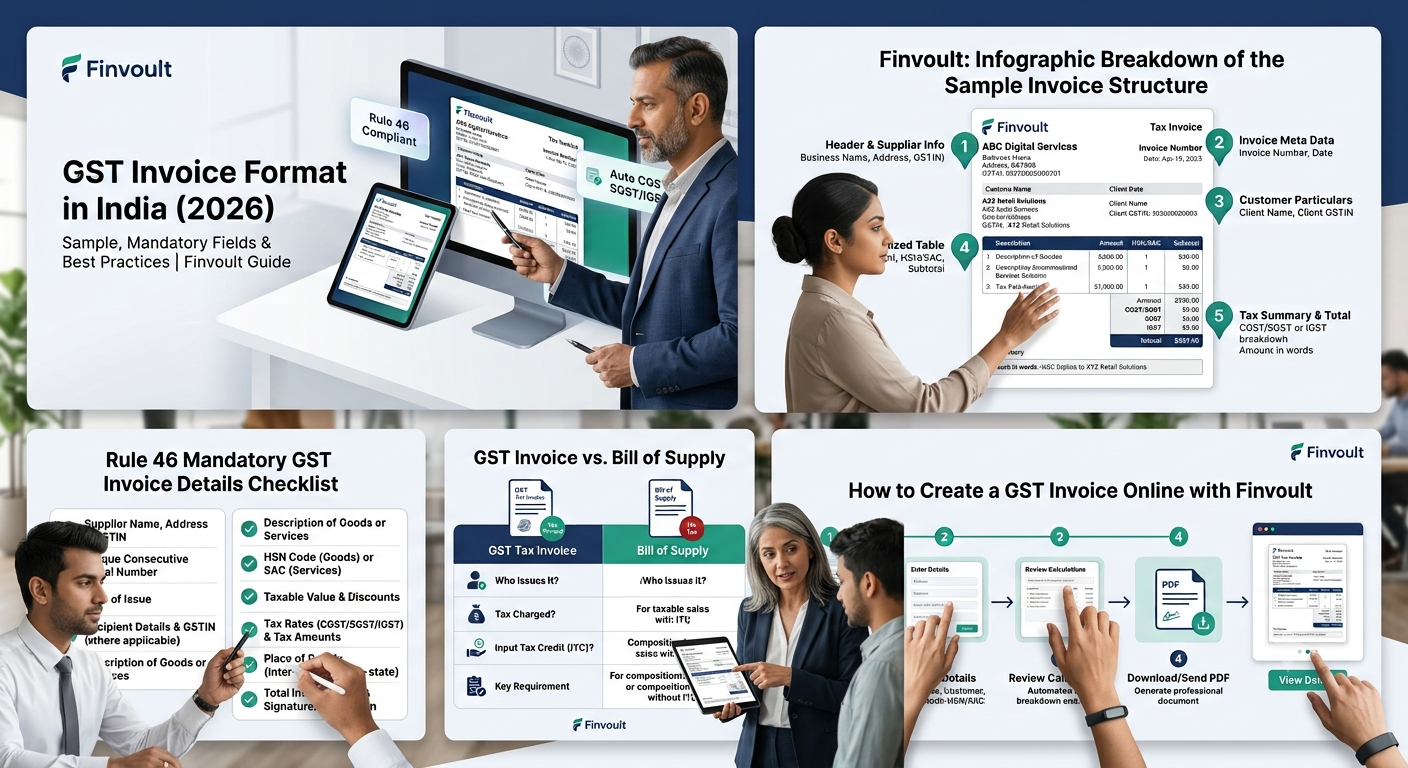
Sample GST Invoice Format
Imagine that a small web development agency in India has completed a project for a business customer.
The agency needs to show the service provided, the agreed price, the applicable GST, and the final amount payable.
Here is an illustrative invoice layout.
TAX INVOICE
Supplier
• Business name: ABC Digital Services
• Address: 21 Business Park, Pune, Maharashtra
• GSTIN: 27ABCDE1234F1Z5 (illustrative placeholder; not a verified GSTIN)
Invoice details
• Invoice number: ADS/2026-001
• Invoice date: 16 October 2026
• Customer: XYZ Retail Solutions
• Customer GSTIN: Enter the verified GSTIN, where applicable
Description Amount
Website development services ₹20,000
Website maintenance setup ₹5,000
Taxable subtotal ₹25,000
Illustrative GST at 18% ₹4,500
Total payable ₹29,500
Amount in words: Twenty-nine thousand five hundred rupees only.
This is an educational example, not a valid invoice for an actual transaction. The business identifiers are illustrative, and the GST rate is assumed solely to demonstrate the calculation.
For an eligible intra-state supply, the illustrative ₹4,500 tax could be split into ₹2,250 CGST and ₹2,250 SGST. For an eligible inter-state supply, IGST generally applies instead. The correct treatment depends on the transaction.
Mandatory Details to Check on a GST Invoice
Rule 46 of the CGST Rules prescribes the particulars applicable to a tax invoice. Use this checklist when reviewing your format.
1. Supplier name, address and GSTIN
Include your business's required identification details. Check that the GSTIN is accurate and belongs to the relevant supplier.
2. Unique invoice number
Use a consecutive serial number, in one or more series, that is unique for the financial year and follows the applicable rules.
For example, a numbering pattern could be INV/2026-27/001. This is an illustrative format, not a mandatory numbering style.
3. Invoice date
Clearly display the issue date. Invoice timing requirements can vary depending on whether you're supplying goods or services and the circumstances involved.
4. Customer information
Include the customer's name, address, and GSTIN or UIN where applicable.
Additional customer and delivery details can be required in specified cases, including certain supplies to unregistered recipients.
5. Product or service description
Describe the supply clearly. If you sell products, include the required quantity and unit details where applicable. For services, use a description that accurately reflects the work performed.
6. HSN or SAC classification
Include the applicable HSN code for goods or SAC classification for services, following the rules that apply to your business.
7. Taxable value and discounts
Show the value of the supply after applicable discounts or adjustments.
Make sure your totals reflect the actual agreed charges.
8. GST rate and tax amount
Display the applicable tax rate and the corresponding tax amount. Depending on the transaction, this may include CGST, SGST, IGST, Union Territory tax, or cess.
9. Place of supply and other particulars
For relevant inter-state transactions, include the prescribed place-of-supply details. Reverse-charge information, delivery details, and other particulars may also be required.
10. Total invoice value
Clearly show the final amount payable, including applicable taxes and adjustments.
Depending on the circumstances, other prescribed requirements, including a signature or digital signature, may apply. Always check the current rules for your specific transaction.
For the official requirements, consult the CBIC GST invoice rules.
How to Calculate GST on an Invoice
GST calculations become easier when you separate the taxable value from the tax amount.
Let's assume your business supplies a service worth ₹10,000 and the applicable GST rate for that service is 18%.
Calculation Amount
Taxable value ₹10,000
GST at the assumed 18% ₹1,800
Total invoice value ₹11,800
The calculation is:
GST amount = Taxable value × GST rate
In this example:
₹10,000 × 18% = ₹1,800
The customer would pay ₹11,800, assuming no discounts, additional charges, or other adjustments.
Remember that 18% is used here only as an example. GST rates vary by goods and service classification. Verify the applicable rate before issuing your invoice.
GST Invoice vs. Bill of Supply
These documents are not interchangeable in every situation.
A GST tax invoice is generally issued by registered suppliers required to issue tax invoices for taxable supplies.
A bill of supply is generally used by eligible composition taxpayers and for exempt supplies, as applicable under GST rules.
Before choosing a template, confirm your registration status and the nature of the supply. If your business is not required or permitted to issue a GST tax invoice for a transaction, using a tax invoice template may be inappropriate.
Common GST Invoice Format Mistakes
Even a professional-looking invoice can contain mistakes. Pay attention to these common problems.
Using the wrong GST rate: Never assume every product or service attracts the same rate.
Missing customer details: Check the recipient's details and include the additional information required for the relevant transaction.
Duplicate invoice numbers: Maintain a systematic numbering process and avoid reusing numbers incorrectly.
Incorrect tax breakdown: Determine whether CGST and SGST or IGST applies based on the applicable rules.
Unclear descriptions: Explain what was supplied rather than using vague labels.
Ignoring e-invoicing requirements: Certain notified taxpayers must follow the prescribed e-invoicing process. A regular PDF invoice does not automatically satisfy mandatory e-invoicing requirements.
Poor recordkeeping: Keep copies of invoices and supporting records organized for accounting and reconciliation.
How to Create a GST Invoice Online with Finvoult
Once you understand the information that belongs on an invoice, preparing one becomes much more straightforward.
Instead of repeatedly modifying old documents, you can use an online invoice generator to organize your billing information.
With Finvoult, you can explore a workflow for creating GST invoices and quotations, entering customer and item details, calculating totals, and generating PDF documents.
Here's a practical approach:
1. Open Finvoult.
2. Start creating an invoice using the available tool.
3. Enter your business and customer information.
4. Add the products or services and their prices.
5. Verify the GST rate and tax treatment for the transaction.
6. Review the invoice details and download the document.
A consistent workflow can reduce repetitive data entry and help you prepare clearer invoices.
However, the final responsibility for accurate details and compliance remains with your business. If e-invoicing or other statutory requirements apply, make sure those are fulfilled separately through the prescribed process.
Frequently Asked Questions
Is there one compulsory GST invoice format in India?
GST rules prescribe the particulars required on tax invoices, but businesses do not all need to use one identical visual layout. Your format must contain the applicable prescribed details.
Can I create a GST invoice in Excel?
Yes. Excel can be used to prepare invoices if the document meets the applicable requirements and the calculations are correct. An online invoice generator can be more convenient for repetitive billing.
Can I download a GST invoice format for free?
Templates may be available online. Before using one, check that it suits your transaction and includes the required particulars. You can also explore Finvoult's invoice-generation options.
How many digits should an invoice number have?
The applicable rules govern invoice numbering. Rule 46 specifies a consecutive serial number, in one or more series, unique for the financial year and subject to the prescribed character limit. Follow the current rules rather than assuming any arbitrary format will qualify.
Can an unregistered business issue a GST invoice?
An unregistered business must not collect GST as though it were a registered supplier. The appropriate commercial document and applicable obligations depend on the business and transaction.
Does a GST invoice PDF automatically count as an e-invoice?
No. Where e-invoicing is mandatory, the prescribed reporting process must be followed. Simply creating or downloading a PDF does not fulfil that requirement.
Final Thoughts
A good GST invoice format makes your billing easier to understand, helps you keep records organized, and presents your business professionally.
Start with accurate supplier and customer information, clear descriptions, the correct tax treatment, and a consistent numbering system. Then choose a layout that makes the final amount and supporting details easy to read.
If you'd like to simplify your everyday invoicing and quotation workflow, visit Finvoult and explore its tools for Indian businesses.
Disclaimer: This article provides general educational information and is not tax or legal advice. GST requirements depend on the taxpayer and transaction and may change. Verify current requirements with official GST resources or a qualified tax professional before issuing invoices.
← All posts
GST Invoice Format in India: Sample, Required Details and Example (2026)
Ready to send your first invoice?
Create a free account and generate a GST-ready invoice in under a minute.
Create free account