GST Invoice Rules in India 2026: Mandatory Fields, Time Limits & Common Mistakes
Creating a GST invoice is an essential part of running a compliant business in India. Whether you are a freelancer, retailer, wholesaler, service provider, or small business owner, understanding GST invoice rules can help you maintain accurate records, bill customers correctly, and reduce avoidable errors.
But generating an invoice is only one part of the process. You also need to know which details must appear on the invoice, when it should be issued, how GST should be calculated, and when special invoicing requirements apply.
In this guide, we explain the key GST invoice rules in India for 2026, with practical examples to help businesses manage their billing more confidently.
What Is a GST Invoice?
A GST invoice is a document issued by a registered supplier for a taxable supply of goods or services. It records the transaction details, taxable value, applicable GST rate, tax amount, and other prescribed information.
A correctly prepared invoice helps the supplier maintain accounting records and gives the customer the documentation needed to support eligible input tax credit claims, subject to applicable GST conditions.
Under Section 31 of the Central Goods and Services Tax Act, 2017, registered suppliers must issue invoices in accordance with the applicable rules.
1. Mandatory Details Required on a GST Invoice
Rule 46 of the CGST Rules, 2017, specifies the principal particulars required on a tax invoice, subject to applicable exceptions and special provisions.
Your GST invoice should generally include the following details:
Supplier details: Legal name, address, and GSTIN.
Invoice number: A consecutive serial number unique for the financial year, within the prescribed format.
Invoice date: The date on which the invoice is issued.
Customer details: Customer name, address, and GSTIN or UIN, where applicable.
HSN or SAC code: The applicable classification code for goods or services, as required.
Description: A clear description of the goods supplied or services provided.
Quantity and unit: Details for goods, wherever applicable.
Total and taxable value: The value of the supply, taking applicable discounts or abatements into account.
GST rate and amount: The applicable tax rate and the corresponding tax amount.
Place of supply: Relevant details for interstate transactions.
Delivery address: Where required, particularly when it differs from the place of supply.
Reverse charge declaration: Whether tax is payable on a reverse-charge basis, where applicable.
Signature or digital signature: Where required under the applicable rules.
Additional particulars may be required for specific transactions, including exports and supplies to Special Economic Zone units.
Tip: Do not assume that every transaction follows exactly the same invoice requirements. Check the provisions applicable to your business and type of supply.
2. GST Invoice Issuing Time Limits
Issuing an invoice at the correct time is just as important as including the correct details.
For the supply of goods
For taxable goods, the invoice generally needs to be issued before or at the time of removal of goods where movement is involved, or before or at the time of delivery or making the goods available in other cases.
Special rules may apply to continuous supplies, approval-based transactions, and other specified circumstances.
For the supply of services
Under the general rule in Rule 47 of the CGST Rules, a tax invoice for taxable services must generally be issued within 30 days from the date of supply of the service.
For insurers, banking companies, financial institutions, including non-banking financial companies, the prescribed period is generally 45 days. Specific provisions may apply to particular classes of suppliers and transactions.
Practical advice: Set up a regular invoicing process so that completed work and delivered goods are billed within the applicable time limits.
3. How to Calculate GST on an Invoice
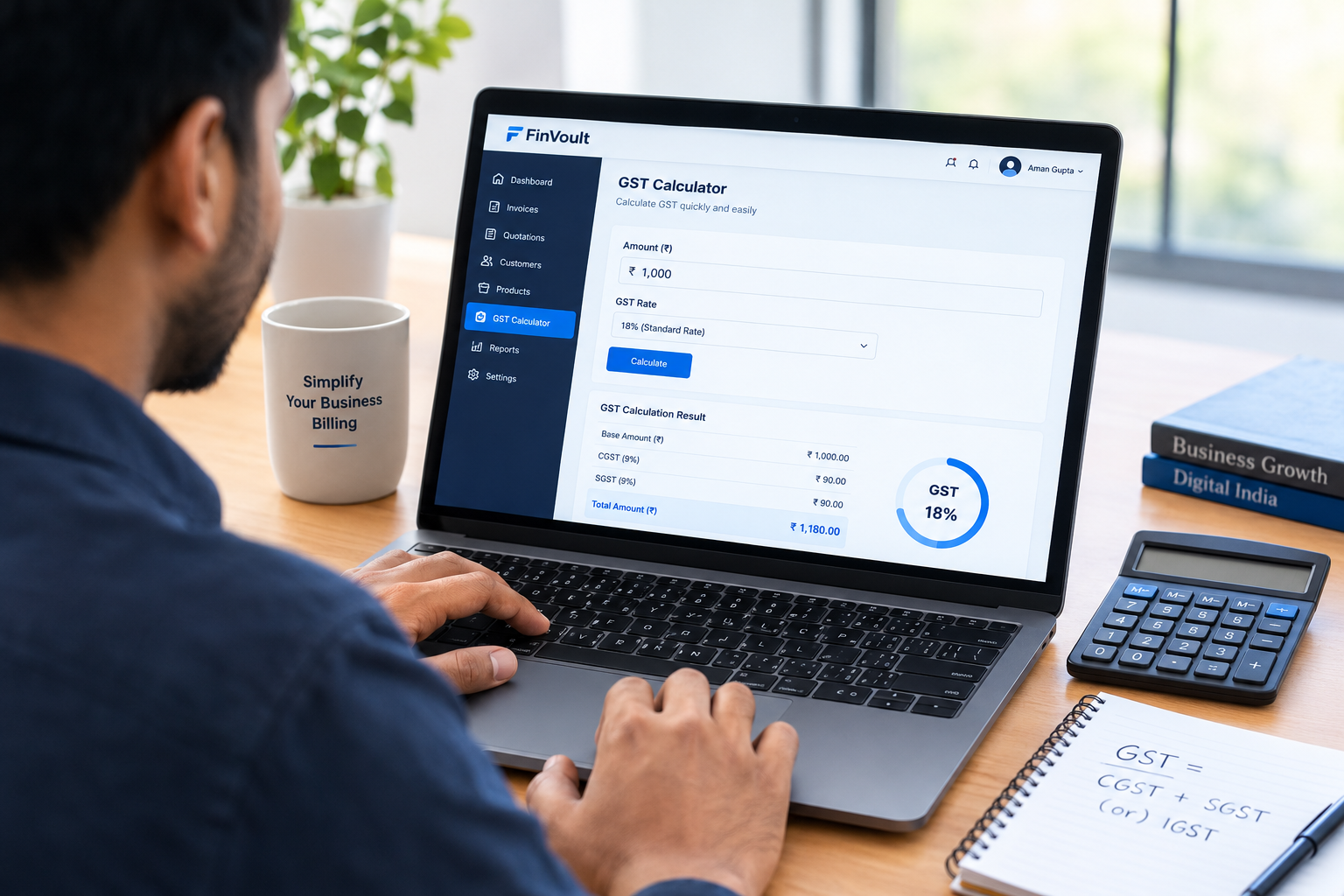
GST is calculated on the taxable value of a supply using the applicable tax rate.
The basic formula is:
GST Amount = Taxable Value × GST Rate ÷ 100
Invoice Total = Taxable Value + GST Amount
For example, suppose a business sells goods worth ₹10,000 before GST, and the applicable GST rate is 18%.
Particulars Amount
Taxable value ₹10,000
GST rate 18%
GST amount ₹1,800
Total invoice value ₹11,800
For an eligible intrastate supply taxed at 18%, the tax would generally be split into CGST of ₹900 and SGST of ₹900.
For an eligible interstate supply taxed at 18%, IGST would generally be ₹1,800.
These examples assume the entire stated value is taxable at 18%, with no additional adjustments. Always verify the correct rate and classification for your specific goods or services.
4. CGST, SGST and IGST: What Is the Difference?
Understanding the type of GST applicable to a transaction helps you prepare the invoice correctly.
CGST: Central Goods and Services Tax, generally charged alongside SGST or UTGST on intrastate taxable supplies.
SGST: State Goods and Services Tax, generally charged alongside CGST on intrastate taxable supplies.
IGST: Integrated Goods and Services Tax, generally applicable to interstate taxable supplies and certain other specified transactions.
The applicable treatment depends on the nature of the supply and the place-of-supply rules. Do not decide the tax treatment solely by looking at the billing addresses.
5. Common GST Invoice Mistakes to Avoid
==>https://finvoult.com/login
Small invoicing errors can create accounting complications and may affect GST compliance.
Incorrect GSTIN
Verify your own GSTIN and the customer's GSTIN, where required. Incorrect customer details can create reconciliation issues.
Duplicate or inconsistent invoice numbers
Use a systematic numbering series and ensure each invoice number follows the applicable requirements for the financial year.
Wrong GST rate
Confirm the correct classification and applicable rate before billing. A familiar rate should not automatically be applied to every product or service.
Incorrect place of supply
Check whether the transaction is intrastate or interstate under the relevant rules before deciding how to charge GST.
Missing invoice particulars
Review the invoice for the required supplier, recipient, tax, value, and transaction details before issuing it.
==>https://finvoult.com/login
Delayed invoicing
Establish a billing schedule that takes account of the applicable invoice deadlines for goods and services.
Poor record keeping
Maintain organised copies of invoices, credit notes, debit notes, and supporting records. This makes reconciliation and record retrieval easier.
6. What Is the Difference Between a Tax Invoice and a Bill of Supply?
A tax invoice and a bill of supply are not interchangeable in every situation.
A registered supplier generally issues a tax invoice for taxable supplies where required. A bill of supply is generally used by eligible suppliers making exempt supplies or by taxpayers paying tax under the composition scheme, subject to applicable provisions.
A bill of supply does not charge GST as a separate tax amount in the way a regular taxable-supply invoice does.
Using the correct document depends on your registration status, tax scheme, and the nature of the transaction.
7. Do You Need GST E-Invoicing?
GST e-invoicing is a separate compliance requirement that applies to notified classes of registered taxpayers and specified transactions, subject to the applicable turnover thresholds, exclusions, and other conditions.
Where e-invoicing applies, the supplier generally needs to report the prescribed invoice information to the Invoice Registration Portal and obtain an Invoice Reference Number (IRN) and applicable QR code.
A PDF invoice created using ordinary billing software is not, by itself, proof that the e-invoicing requirements have been fulfilled.
Before relying on an invoicing workflow, check whether your business falls within the current e-invoicing requirements and whether any applicable reporting timelines or restrictions affect the transaction.
8. How to Create a GST Invoice Easily
A consistent invoicing workflow helps reduce repetitive work and avoid common mistakes.
Follow these steps:
Enter your business name, address, and GSTIN.
Add the customer details required for the transaction.
Assign a unique invoice number and invoice date.
Describe the goods or services supplied.
Add the applicable HSN or SAC details and quantity, where required.
Enter the taxable value, discounts, and applicable GST rate.
Check the tax calculation and place-of-supply details.
Add any other particulars required for your transaction.
Review the invoice before issuing it and retain the appropriate records.
==>https://finvoult.com/login
Using a structured invoice template or billing tool can make this process easier, but you should still verify the invoice against the rules applicable to your business.
9. GST Invoice Compliance Checklist
Before issuing a GST invoice, review the following checklist:
Supplier details and GSTIN are correct.
Customer details are included where required.
Invoice number and date are valid.
Goods or services are clearly described.
Applicable HSN or SAC details are included.
Taxable value and discounts are correct.
GST rate and tax amount are accurate.
Place-of-supply and tax-type details are correct.
Special declarations or e-invoicing requirements have been checked.
A copy of the invoice is retained for record keeping.
This checklist is a practical review aid, not a substitute for the complete statutory requirements or transaction-specific rules.
Frequently Asked Questions
Is a GST invoice mandatory for every sale?
Not necessarily in the same form for every transaction. The applicable requirements depend on registration status, the type of supply, and relevant exceptions. Registered suppliers making taxable supplies generally need to issue tax invoices as prescribed.
What is the usual deadline for issuing a GST invoice for services?
The general deadline is within 30 days from the date of supply of services. A 45-day period applies to specified categories of suppliers, and special provisions may apply to certain transactions.
Can I correct a GST invoice after issuing it?
The appropriate correction method depends on the error and the circumstances. Depending on the case, the applicable rules may require a credit note, debit note, revised invoice where permitted, or correction of reported details. Do not simply alter an issued invoice without considering the relevant compliance requirements.
Is an e-invoice the same as a PDF invoice?
No. GST e-invoicing involves reporting prescribed invoice data through the Invoice Registration Portal and obtaining the required registration particulars where the mandate applies. A PDF is only a document format.
What is the difference between CGST and IGST?
CGST generally applies with SGST or UTGST to intrastate taxable supplies. IGST generally applies to interstate taxable supplies, subject to the relevant place-of-supply provisions.
Conclusion
Following GST invoice rules helps businesses maintain accurate billing records, improve transaction transparency, and manage compliance more effectively.
From including the correct invoice particulars to applying the appropriate GST rate and meeting issue deadlines, a consistent invoicing process can prevent many avoidable errors.
Before issuing an invoice, review the transaction details and verify whether any special rules apply to your business.
Looking for a simpler way to manage your invoicing? Explore the invoice creation resources available on Finvoult and build a billing workflow that works for your business.
Disclaimer: This article is for general educational purposes and is not legal or tax advice. GST requirements may change, and specific exceptions or notifications may apply. Consult the current legislation, official GST guidance, or a qualified tax professional for advice on your circumstances.
Official references
Central Board of Indirect Taxes and Customs (CBIC): GST Invoice Rules — https://cbic-gst.gov.in/gst-invoice-rules.html
CBIC GST Tax Information Portal: CGST Rules, Rule 46 — https://taxinformation.cbic.gov.in/content-page/explore-rules/1000136/1000001
CBIC GST Tax Information Portal: CGST Act, Section 31 — https://taxinformation.cbic.gov.in/content-page/explore-act/1000300/1000001/invoice/ACTS
==>https://finvoult.com/login
Disclaimer: This article provides general educational information and is not tax or legal advice. GST requirements depend on the taxpayer and transaction and may change. Verify current requirements with official GST resources or a qualified tax professional before issuing invoices.
← All posts
GST Invoice Rules in India 2026: Mandatory Fields, Time Limits & Common Mistakes
Ready to send your first invoice?
Create a free account and generate a GST-ready invoice in under a minute.
Create free account